
The Assumption That Keeps Killing Change
I believed it for years. It just didn’t survive real work.

I used to believe that clarity was enough.
That if I explained something well, slowly, logically, with clean steps, people would carry it with them and use it when it mattered.
I remember sitting in rooms where everything felt right.
The slides were polished.
The process was elegant.
The logic tracked.
You could almost feel the relief in the room: Finally, this makes sense.
Then I started paying attention to what happened afterward.
In the hum of everyday work, the noise, the interruptions, the pressure, people adapted. They found faster ways. Quieter ways. Ways that let them breathe.
Not reckless ways.
Human ones.
I watched teams shave seconds off tasks, reroute steps, and bypass systems not because they didn’t know better, but because they were trying to survive the day.
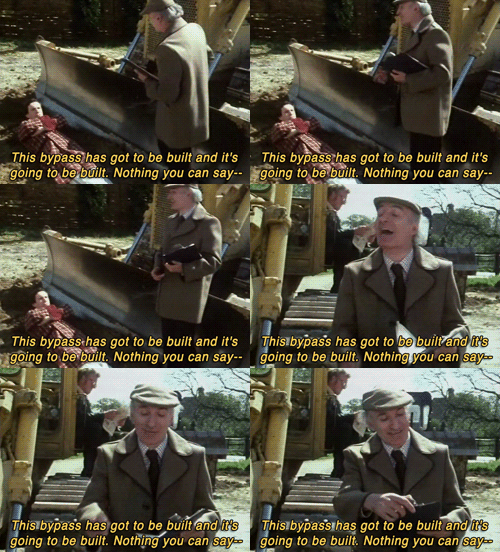
Up close, those choices made sense.
From a distance, they broke everything.
That’s when I realized something uncomfortable.
The gap wasn’t between knowing and doing.
It was between what made sense in theory and what felt possible in the moment.
When the clock is ticking.
When someone’s waiting.
When the “right way” feels heavier than the shortcut.
That’s where the assumption fell apart.
So I stopped starting with explanations.
I started listening for hesitation.
For the moment someone pauses.
For the quiet calculation happening before a decision is made.
I began asking different questions:
What feels risky here?
What feels safer?
What is this person protecting when they choose the shortcut?
Only then did learning begin to feel alive again.
What you can take with you this week
The next time you notice someone not doing what was taught, pause before correcting.
Instead of asking, “Do they understand?”
Try asking yourself:
“What conditions are making this choice feel like the safest one right now?”
That single shift changes how you respond:
From fixing people → to fixing conditions
From pushing harder → to designing smarter
From frustration → to insight
It’s a small move, but it opens up entirely different conversations.
That’s the space I want to explore here.
The space between good intentions and real behavior.
Between well-designed plans and the humans tasked with carrying them out.
Not to fix people but to understand them.
Next time, I want to talk about what happens inside us when change feels threatening.
The moment when logic is still intact, but something emotional takes over.
The leadership skill we rely on most is usually the first to disappear.
That’s where we’ll go next week.
Thanks for being here and for thinking alongside me as we make sense of how change actually works.
— Ali 🧡